


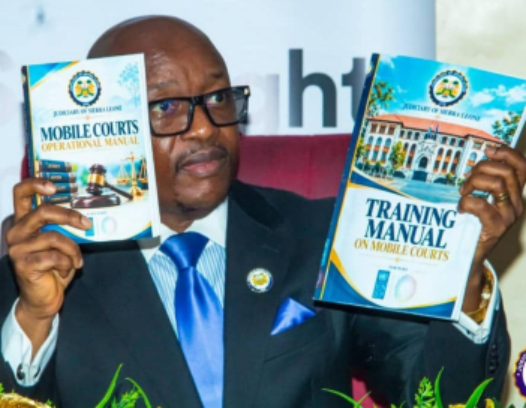
Chief Justice, His Lordship Honourable Justice Komba Kamanda, has launched the country’s first Training Manual and Mobile Courts Operational Manual for handling Gender-Based Violence (GBV) cases.
Developed with support from the United Nations Development Programme (UNDP), the two manuals will serve as practical guides for judicial officers and justice sector institutions involved in the administration of justice during mobile court sessions.
In his keynote address at the launch, Chief Justice Kamanda said geographical distance, poor road networks and transportation challenges had long served as barriers to access to justice, particularly for women and girls in remote communities.
He explained that mobile High Court sessions would provide an important opportunity to bring judicial services closer to the people, with particular focus on Falaba, Moyamba and Kailahun districts where access to formal courts remains limited.
The Chief Justice emphasised that the manuals do not replace the Constitution, applicable legislation, court rules or lawful judicial orders. Rather, he said, they are intended to support the effective administration of existing laws while fully respecting the independence of the Judiciary and the distinct responsibilities of every institution involved in the justice delivery process.
He further stressed that the responsibility for delivering justice does not rest with the Judiciary alone.
“Judges, Registrars, Prosecutors, Defence counsel, Police, Correctional authorities, Legal aid providers and other key stakeholders must work collaboratively, with each institution operating within the limits of its lawful mandate,” he said.
Chief Justice Kamanda encouraged participants to regard the manuals not as documents to be placed on shelves, but as practical working guides that inform their daily responsibilities and strengthen the administration of justice.
Officially declaring the one-day training open, the Chief Justice set a clear benchmark for measuring success.
“When this training ends, our success should not be judged simply by attendance or the number of sessions completed,” he stated.
He added that the true measure of success should be reflected in better preparation, stronger institutional cooperation, more efficient case management, improved protection of confidentiality and greater accountability across the justice sector.
On his part, UNDP Deputy Resident Representative Kevin Petrini said the manuals reinforced the importance of a survivor-centred approach to handling GBV cases. He noted that survivors of violence must be treated with dignity, respect, confidentiality and sensitivity throughout the judicial process.
“Through this manual, the Judiciary is also taking an important step towards enhancing the efficiency of justice delivery by clarifying roles, standardising procedures and strengthening coordination among institutions responsible for administering justice,” Mr. Petrini said.
He congratulated Chief Justice Kamanda and the Judiciary on what he described as an “important achievement” and expressed optimism about the continued impact of mobile courts in expanding access to justice and reducing impunity across the country.
The launch marks a significant step in Sierra Leone’s justice reforms, as mobile courts are increasingly being used to decongest the court system and bring justice to hard-to-reach areas where GBV cases often go unreported or unresolved due to distance and cost.
EDITORIAL
SIERRA LEONEANS NEED A SOCIAL CONTRACT, NOT SOCIAL COHESION
Sierra Leone does not need another conference to be told that it is divided. It needs a government that keeps its word.
The recently concluded Peace and Social Cohesion Conference, convened with little publicity and thin civic participation, invites a sober national question: Is Sierra Leone being offered a SOCIAL CONTRACT, or merely a SOCIAL CEREMONY?
A PROCESS THAT LACKED INCLUSION
A genuine national dialogue is judged by who is in the room and what is on the agenda. Civil society, faith-based bodies, women’s and youth organisations, professional associations, the media and ordinary citizens are the custodians of a nation’s conscience; their presence cannot be a courtesy.
Yet what we saw at Bintumani was an elite arrangement among political actors, with the wider public as spectators. Those invited appeared largely as inherent followers and beneficiaries of President Ernest Bai Koroma and President Maada Bio. There is no significant legitimacy in a cohesion conference where the moral guardians of society are absent. Where legitimacy is absent, consensus is merely choreography.
THE QUESTION OF TIMING
Cohesion and constitutional reform cannot credibly be pursued at the same moment through opposing instincts. The constitutional review process has travelled between the courts and the political arena, leaving citizens confused and suspicious.
When a contested constitutional review and a cohesion conference arrive together, the public is entitled to ask whether this is statesmanship or strategic bargaining, and whether peace is being used to manage consent for decisions that have not yet been honestly debated. Transparency, not timing, is the only answer that will satisfy a sceptical citizenry.
REPRESENTATION AND THE OPPOSITION
The All Peoples Congress has an elected executive. Legitimate opposition participation should therefore flow through its institutional structures, not through the personal prominence of any individual, however distinguished his past.
Many within the APC perceive that former President Koroma’s central role serves his personal security and continued relevance more than the renewal of the party. Whether or not that perception is fair, it is widely held, and a cohesion process that deepens mistrust inside the principal opposition has already defeated its own purpose.
An opposition that is perceived to be negotiating its terms privately cannot hold power to account publicly.
WHY THE SOCIAL CONTRACT IS THE REAL SUBJECT
The speakers at the conference, in different words, kept returning to one theme: the obligations of the state to its people. That is the essence of the social contract.
Citizens surrender a measure of liberty and accept authority; in return, the state guarantees security, justice, welfare and opportunity. Government exists to serve, not to rule. When that bargain is honoured, cohesion follows naturally. When it is breached, no conference can manufacture it.
Measured against that standard, the indicators of fragility are difficult to ignore:
1. Livelihoods:Chronic poverty, hunger, runaway inflation, unaffordable basic commodities, mass unemployment and underemployment.
3. Public Services: Failing health facilities, inadequate social care and a steady decline in the quality of education.
4. Security and Order: Political thuggery, internecine political violence, hate crimes and growing concerns over the discipline of security forces.
5. Pervasive drug dealing, rising addiction and drug-related deaths among the youth, together with public disquiet over reports that a wanted drug trafficker has been harboured in the country.
6. Endemic corruption and a yawning gap between manifesto promises and delivered outcomes.
These are not abstractions. They are the daily experience of millions of Sierra Leoneans, and they are the true threats to national peace. A nation that is hungry, unemployed and unprotected is not cohesive, whatever the communiqués say. You cannot decree cohesion on an empty stomach.
A government that serves earns peace; a government that performs only borrows it.
Social cohesion is an outcome; the social contract is its foundation. To invert them is to treat the symptom and neglect the disease.
A credible national agenda would begin with enforceable commitments: transparent appointments, an honest and consultative constitutional process, accountable use of public resources, and measurable action on jobs, health, education and the narcotics crisis, with civil society as an equal monitor.
Cohesion negotiated privately, and announced afterwards through appointments, will not command public trust. The people do not need a performance of unity. They need a government that serves, an opposition that is independent, and institutions that answer to citizens.
Sierra Leone deserves a social contract honoured in substance, not a social cohesion declared in ceremony.
The international community, our development partners and our citizens should take note: The Peace and Social Cohesion Conference, as presently constituted, risks becoming a diabolical trap against people’s democracy. It is a pathway to destruction dressed as inclusion.
Why now? The nation awaits the constitutional review deal that masterminds the diabolical construction of political inclusion in governance, where the APC opposition will be offered a quota in Bio’s regime in exchange for silence.
We reject cohesion without justice. We demand contract over ceremony.